
Forms, selectors and messages
Use private replies to talk to the caller and public controls when an action belongs to the group. Start with Your first bot. Beyond commands, public examples need send_messages; polls need selectors, and reactions/quotes can also require read_messages. See the capability matrix.
Reference: CommandContext, BotForm, BotChoice and BotSelector.
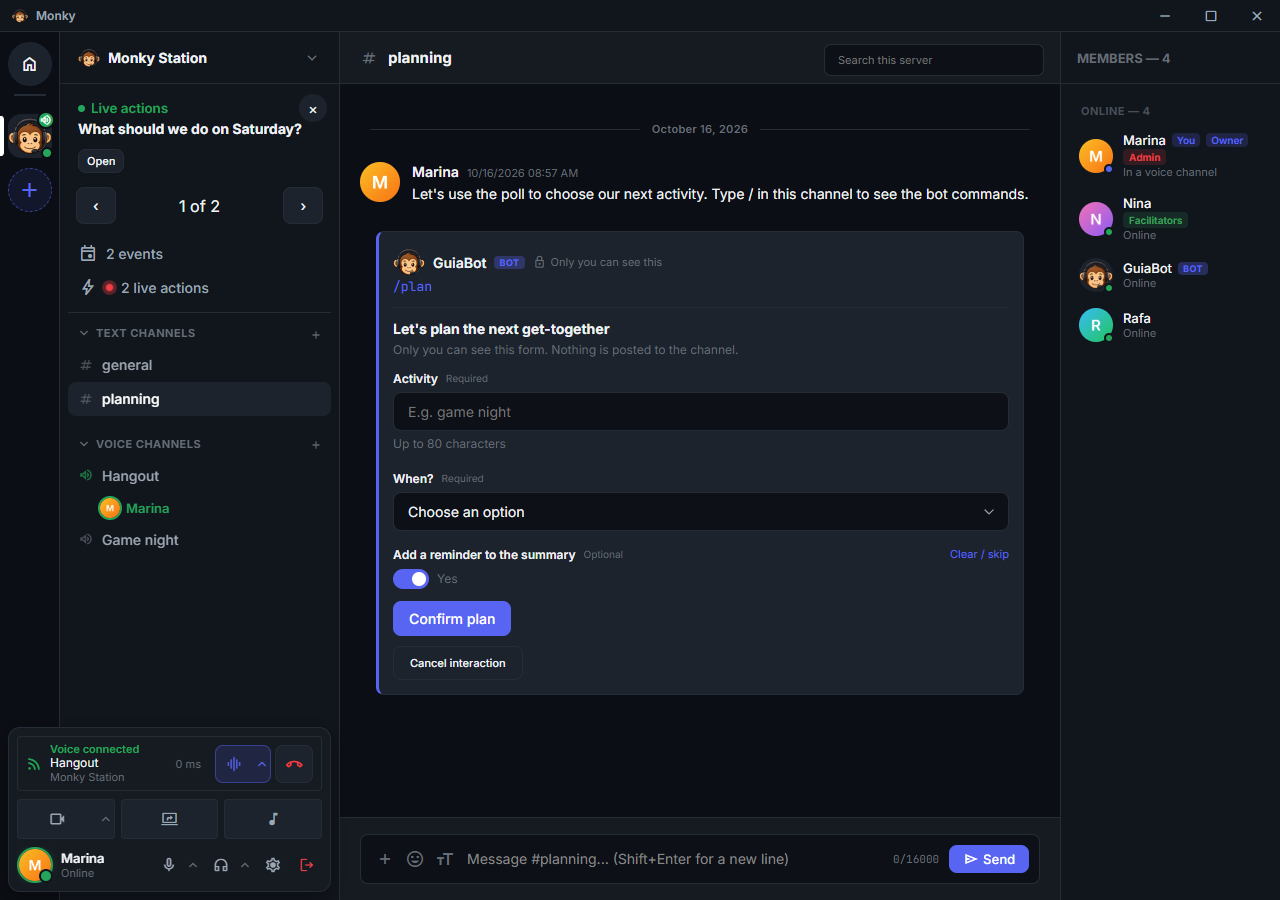
Native live actions
With protocol 31, ctx.createLiveAction() highlights an interaction above channels. Declare commands and live_actions, obtain administrative approval and grant Emit live actions to the command caller's role. The server derives the caller and channel from the invocation; bots cannot supply their identity. This contract accepts no HTML, iframe, JavaScript or application URL.
bot.command({
  name: 'confirm',
  description: 'Open a group confirmation',
  handler: async (ctx) => {
    await ctx.createLiveAction({
      title: 'Confirm participation',
      expiresAt: Date.now() + 15 * 60_000,
      audience: {
        visibility: 'private',
        userIds: ['member-id'],
        roleIds: ['role-id'],
      },
      content: {
        kind: 'form',
        form: {
          title: 'Participation',
          fields: [{ name: 'name', label: 'Name', type: 'text', required: true }],
        },
      },
    });
  },
});
bot.onLiveActionSubmission((submission, { serverId }) => { ... }) returns an unsubscribe function. submission contains server-validated id, submissionId, userId, userNickname, channelId, locale and values. Acknowledgement confirms forwarding to the bot, not completion of an external operation. Form responses are not stored as poll history.
For durable voting, create a selector with ctx.createSelector() and use content: { kind: 'selector', selectorId: selector.id } in the live action. This also requires selectors and send_messages; votes use the existing selector, not a second store. The banner disappears when the selector closes or the action expires.
Use bot.listLiveActions(serverId), bot.updateLiveAction(serverId, { id, expectedRevision, ...patch }) and bot.closeLiveAction(serverId, id) to recover, update and close actions. Deadlines are limited to 30 days per operation, with 50 simultaneous actions per server. Definition changes invalidate older forms. Actions do not grant private-channel access and capability review remains mandatory. The member who started the Live Action and members with Emit live actions can also end it manually from the action details.
Without audience, an action is public. A private action uses { visibility: 'private', userIds, roleIds } with at least one ID; members and roles have OR semantics. The server reevaluates role membership and channel read access in real time. The creator and Manage server moderators retain access, but links and the Live Action itself never grant channel access. updateLiveAction can replace the audience or return to { visibility: 'public' }.
Private replies and publishing
ctx.reply() and ctx.replyEphemeral() are private: only the calling connection sees the response in the same chat where the command started. This is neither a direct message nor a message published to other members.
Replies appear in cards with the bot's name, photo, and badge, plus “Nickname used /command” context. The server supplies the caller's identity and the command name; bots cannot impersonate another caller. This reference does not expose parameter values, including when a result is published to the channel.
bot.command({
  name: 'secret',
  description: 'Tells you a secret',
  handler: (ctx) => {
    ctx.replyEphemeral('🤫 Only you can see this!');
  },
});
To deliberately share a result, use ctx.publish('Result for the channel'). Publishing respects channel visibility, is persisted in history, and supports reactions; forms and their answers remain private. Private command replies are temporary and are not part of the channel's persisted history.
Forms and multi-step conversations
A bot can wait for user input without opening a modal or requesting manually formatted messages. Each await ctx.prompt(...) creates a form inside the caller's chat. Answers from different users, devices, and servers stay isolated.
bot.command({
  name: 'list',
  description: 'Publish a list using a form',
  handler: async (ctx) => {
    const result = await ctx.prompt({
      title: 'New list',
      fields: [
        { name: 'question', label: 'Question', type: 'text', required: true, maxLength: 200 },
        {
          name: 'options', label: 'Options', type: 'string-list',
          required: true, minItems: 2, maxItems: 10, maxLength: 80,
          placeholder: 'One option per field',
        },
      ],
    });
    if (!result) return;
    if (typeof result.question !== 'string' || !Array.isArray(result.options)) {
      throw new Error('Unexpected form answer');
    }
    const text = `**${result.question}**\n${result.options.map((option, i) => `${i + 1}. ${option}`).join('\n')}`;
    ctx.publish(text);
  },
});
Available field types are text (with optional multiline), integer, select, boolean, string-list, and image-list. All accept name, label, description, and required; compatible fields also accept defaultValue. Use defaultValue to edit a previous step, and the form's submitLabel to customize its submit button.
Image carousels
image-list returns zero to five temporary references bound to the person and channel that uploaded the images. Its presentation is declarative and reusable:
const result = await ctx.prompt({
  title: 'Choose images',
  fields: [{
    name: 'images',
    label: 'Images',
    type: 'image-list',
    maxItems: 5,
    presentation: {
      format: 'landscape', // banner | landscape | square | portrait
      fit: 'contain',      // cover | contain
      size: 'regular',     // compact | regular | wide
    },
  }],
});
if (!result) return;

const images = result.images;
if (Array.isArray(images) && images.length > 0) {
  ctx.reply({
    content: 'Preview of the selected images',
    components: [{
      type: 'carousel',
      imageAssetRefs: images,
      label: 'Selected images',
      presentation: { format: 'landscape', fit: 'contain', size: 'regular' },
    }],
  });
}
The reply component is private and temporary, like ctx.reply() itself. It is not accepted by ctx.publish(), sendMessage(), or persistent selector results. For a durable shared surface, create a Live Action with imageAssetRefs and the same settings in imagePresentation:
await ctx.createLiveAction({
  title: 'Gallery',
  description: 'Review the images before choosing an option.',
  expiresAt: Date.now() + 15 * 60_000,
  imageAssetRefs: images,
  imagePresentation: { format: 'square', fit: 'cover', size: 'compact' },
  content: {
    kind: 'form',
    form: {
      title: 'Choice',
      fields: [{ name: 'confirm', label: 'Confirm', type: 'boolean', required: true }],
    },
  },
});
Each reference can be promoted once. cover opens the cropper using the chosen format; contain preserves the complete image and applies fitting at render time. Presets bound width and aspect ratio in the client and remain responsive, without accepting arbitrary CSS, pixels, or URLs from the bot.
Once the server accepts a submission, the form disappears from chat and its values are discarded in the client. If submission fails, the form retains the entered values and displays the error so the caller can try again.
prompt() returns null if the conversation is cancelled, expires, or loses its connection. Return from the handler in that case; use ctx.signal to cancel external operations. Only one form may be pending per invocation: await it before opening the next. Limits are 10 fields, 20 choices/list items, and five simultaneous commands per connection. Each invocation lasts at most five minutes and 100 steps; opening another form does not reset that deadline. A bot cannot send replies after its handler has finished.
Private selectors
ctx.choose() simplifies questions with one choice. With presentation: 'buttons', clicking responds immediately; with 'dropdown' (the default), the caller selects and confirms. The response is the declared value, or null when the interaction ends. Each step is visible only to the caller.
bot.command({
  name: 'activity',
  description: 'Choose an activity in two steps',
  handler: async (ctx) => {
    const activity = await ctx.choose({
      title: 'What should we do?',
      presentation: 'buttons',
      choices: [
        { label: 'Play', value: 'game' },
        { label: 'Chat', value: 'chat' },
      ],
    });
    if (activity === null) return;
    const time = await ctx.choose({
      title: 'When?',
      submitLabel: 'Confirm time',
      choices: [
        { label: 'Now', value: 'now' },
        { label: 'Later', value: 'later' },
      ],
    });
    if (time !== null) ctx.reply(`Choice: ${activity}, ${time}`);
  },
});
You can also use presentation: 'buttons' on a select field in ctx.prompt(). Clicking validates and submits the entire form, so other required fields must be filled first.
Public selectors and voting
For questions that should remain in the channel, use bot.createSelector(serverId, definition). Unlike a private invocation, the selector is persisted on the server and remains available after disconnections. Buttons respond on click; dropdowns require confirmation.
const selector = await bot.createSelector(serverId, {
  channelId,
  title: 'Which activity should we organize?',
  choices: [
    { label: 'Tournament', value: 'tournament' },
    { label: 'Chat session', value: 'chat' },
  ],
  presentation: 'buttons',
  responder: 'any',
  allowChange: true,
  expiresAt: Date.now() + 60 * 60 * 1000,
  maxResponders: 50,
});
responder: 'any' accepts human members with channel access and permission. To restrict responses to one person, use 'invoker' with their invokerId. Each person has one response; allowChange lets them replace it without increasing the participant count. maxResponders: 1 closes on the first valid response. Provide a deadline (expiresAt), a participant limit (maxResponders), or both; the first limit reached closes the interaction. The maximum duration is 30 days and the maximum participant limit is 10,000.
The selectorUpdate event delivers { serverId, selector } to the owning bot, including responses by user ID. Other clients receive only totals and their own choice. Register the listener once for the bot's lifecycle and remove it on shutdown. Use bot.listSelectors(serverId) after connecting to recover states, updateSelector(serverId, id, patch) to adjust title/limits, and closeSelector(serverId, id) to close manually.
Inside a command, prefer ctx.createSelector(definition) — channelId and invokerId are supplied automatically. The server binds creation to the real invocation, allowing polls in private channels the caller can access. This authorization applies only to that selector and channel; it does not grant the bot general access to private messages or reactions. Later operations and recovery revalidate the creator's current permissions. If that person loses access, the bot stops receiving responses and cannot publish results until authorization is restored. Standalone bot.createSelector() still requires the bot's own channel access.
After closure, await bot.finalizeSelector(serverId, id, content) publishes the result to the channel idempotently: repeating finalization does not create another message. This lets processing recover after a bot crash. Do not keep a private handler open while waiting for a long-running vote.
Reactions and emoji responses
Persisted text-channel messages support reactions through the emoji picker. Each person may add different emojis, but only one reaction per emoji; clicking again removes their own reaction. Totals and the names of people who reacted are available in chat and survive history loading. Temporary private command replies do not receive public reactions.
In the SDK, bot.sendMessage(serverId, channelId, text) awaits publication and returns the message with its id. addReaction(serverId, channelId, messageId, emoji) and removeReaction(...) change only the bot's own reaction. The reactionAdded and reactionRemoved events provide channel, message and user IDs, the user's nickname, and the emoji, with { serverId } as the second argument. Typed helpers onReactionAdded and onReactionRemoved return an unsubscribe function.
To publicly reply to a persisted message, use bot.sendMessage(serverId, channelId, text, { replyToMessageId: id }). The fourth argument is optional; existing calls keep working. The server requires a non-deleted original in the same accessible channel and returns its resolved reference in message.reply. This differs from ctx.reply(), which remains a private command response.
A question can continue the command after a valid reaction without mixing responses from other channels or users:
bot.command({
  name: 'confirm',
  description: 'Answer a question with an emoji',
  handler: async (ctx) => {
    const message = await bot.sendMessage(ctx.serverId, ctx.channelId, 'Continue? React with 👍 or 👎.');
    const answer = await new Promise<string | null>((resolve) => {
      const finish = (value: string | null) => {
        detach();
        ctx.signal.removeEventListener('abort', onAbort);
        resolve(value);
      };
      const onAbort = () => finish(null);
      const detach = bot.onReactionAdded((reaction, { serverId }) => {
        if (serverId === ctx.serverId && reaction.channelId === ctx.channelId &&
            reaction.messageId === message.id && reaction.userId === ctx.invokerId &&
            ['👍', '👎'].includes(reaction.emoji)) finish(reaction.emoji);
      });
      ctx.signal.addEventListener('abort', onAbort, { once: true });
      if (ctx.signal.aborted) finish(null);
    });
    if (answer !== null) ctx.reply(answer === '👍' ? "Let's continue!" : "Okay, we'll stop here.");
  },
});
The example accepts only the caller's first valid reaction and removes the listener on response, cancellation, disconnection, or expiry. Ordinary reactions remain independent of this flow.